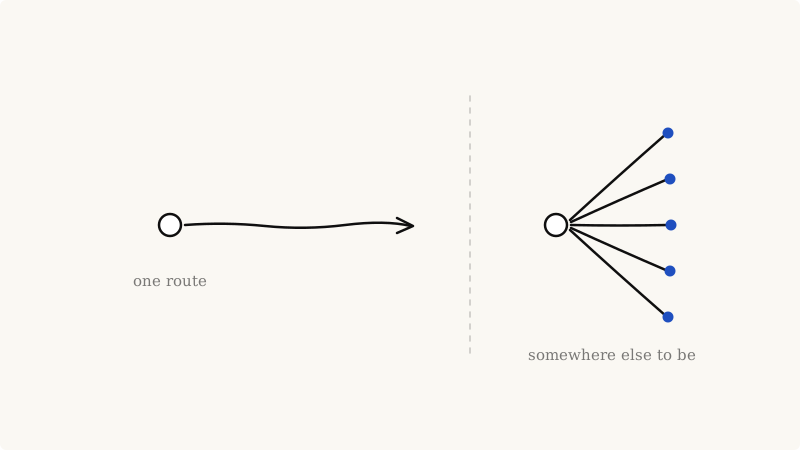
Most preparation advice is about arriving at a better number. That is not really what preparation buys you. It buys you the ability to be having more than one conversation, and the number comes out of that.
You will not be selling alone
Australian business ownership has been ageing for a generation. The Australian Small Business and Family Enterprise Ombudsman reported in 2023 that the most common age of a small business owner had reached 50, against 45 in 2006, and that more than one in five owners were aged 60 or over. In the 1980s there were twice as many owners aged between 30 and 49 as there were aged over 50. That ratio has since inverted.
These are not marginal businesses. On Australian Bureau of Statistics data compiled by the Ombudsman, businesses employing fewer than 20 people added nearly $590 billion of value in 2022-23, roughly a third of GDP, with medium-sized businesses contributing a further $410 billion.
So a great many owners are going to reach this decision within a few years of one another, and the buyers know it. Capital for good mid-market businesses is available and it is not sentimental about waiting. An acquirer who finds your accounts unclear and your management thin does not usually say so and come back in a year. They move to the next business on the list, which is already in order. Nobody tells you that you were passed over, and that is the part owners find hardest to plan for.
That is the competition that actually decides your outcome, and it is not the competitor you think about. It is the owner two suburbs over who spent the last eighteen months getting ready.
Preparation is leverage, and leverage is counted in options
Owners tend to think of preparation as work that raises the number. It is really work that raises the count.
A prepared business can run a process or entertain a single approach, take cash or take a partner, sell all of it or part of it, complete this year or wait for next. An unprepared business gets one buyer, one structure, one timetable, and a price set by whoever happened to turn up.
The number follows from the count, not the other way round. A business with clean accounts, a management layer that functions without you, and revenue that does not lean on three relationships is not merely more attractive. It changes the tenor of every conversation, because the person opposite can tell you have somewhere else to be.
That is worth being precise about. The ability to say no is not a tactic you deploy on the day. It is a condition of the business, established months beforehand, and an experienced acquirer can read it in your accounts before you have said a word.
Why one buyer feels like the careful option
Negotiating with a single buyer costs you leverage, and it is still the route many owners instinctively prefer. That is not a failure of judgement. It is an asymmetry.
You have spent thirty years becoming the most knowledgeable person alive about your business, and almost none becoming knowledgeable about the market for businesses like it. The person across the table has done this eleven times this year. One quiet conversation with somebody who already understands your industry feels like the careful, discreet, grown-up version. It is the version where that asymmetry counts for most.
We have seen the same buyer behave differently inside a fortnight, on the same asset, depending only on whether they believed anyone else was looking.
What legacy costs when it sets the capital budget
For most owners the business is decades of effort, identity and money, and that attachment does real work in the accounts. It shows up as capital spent on things that carried meaning rather than a return.
The premises bought rather than leased, because owning them felt like having arrived. The division kept alive because of who works in it. The equipment specified for a contract that never repeated. Each of those is a decision you can defend, and a buyer still has to fund it out of the price they offer you.
The same pattern turns up in commercial arrangements. Supplier and customer agreements built around relationships rather than terms. A twenty-year handshake is a genuine asset to you and an undocumented dependency to an acquirer, and they price the version they can enforce.
Then there are the unglamorous items that decide whether the last month of a transaction is calm. Wage compliance. Corporate governance. Entity and tax structure. Addressed early they are administration. Left alone they arrive as late surprises, at the point in a deal where surprises cost the most.
The questions worth answering before anyone asks them
There is a short list worth running against your own business this quarter.
Do the shareholders agree on why and when. Does the growth story survive a stranger reading it. Would the leadership team impress an acquirer with you out of the room. Can core and non-core be separated. Are the financials clear and credible. Is the structure one an investor could actually buy into. Are the wage and governance risks known rather than assumed.
Not one of those questions requires a decision to sell. That is rather the point of them. If any one of them stops you, you have not found a reason to delay. You have found the work.
Preparation is not what you do once you have decided to sell. It is what keeps the decision yours.
General information for Australian business owners considering a sale. It is not legal, financial or tax advice, and your own circumstances decide the answer. Owner-age figures are from the Australian Small Business and Family Enterprise Ombudsman, August 2023. Contribution-to-GDP figures are ABS Australian Industry data for 2022-23, compiled by the Ombudsman, where small business means fewer than 20 employees. Current as at August 2026.